The vehicle stopped. The driver says something came into the danger zone behind him. Maybe it was a pedestrian. Maybe a site operative walked into the reversing area. Maybe it was a bollard, a barrier, a piece of plant or another wagon that nobody had eyes on. By the time anyone gets round to asking, the moment has gone and you are left with one person’s recollection of an event that lasted two seconds.
Until now, ReverseSmart could tell you the brakes had been applied automatically. It could not show you what triggered them.
A new camera option changes that. It records the area behind the vehicle, date and time stamps the footage and notifies the fleet manager as soon as an intervention happens. You get the alert and the evidence together, rather than hearing about it three days later at the end of a shift handover.
What ReverseSmart already does
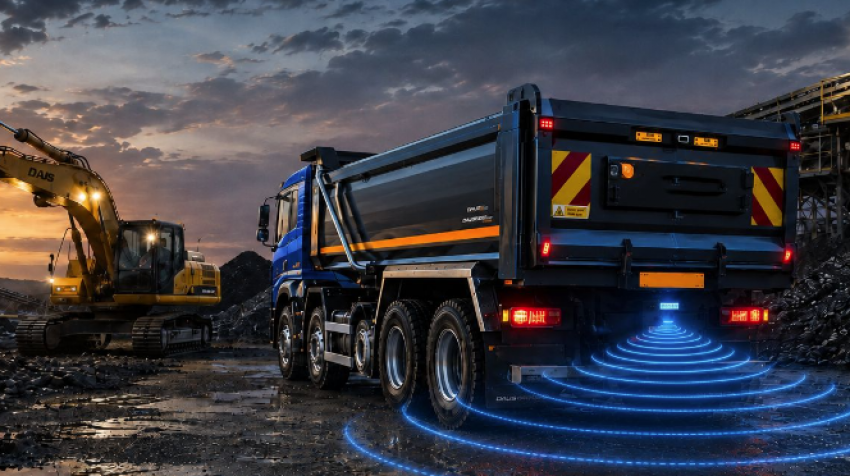
ReverseSmart uses 77GHz radar to monitor a configurable zone behind the vehicle. If something enters that zone, the driver gets an audible and visual warning. If the driver does not react, the system applies the service brakes and brings the vehicle to a controlled stop.
Zones and detection distances are set to suit the vehicle and the environment, which matters more than it sounds. A tipper reversing on a quarry haul road and a refuse vehicle backing into a terraced street need very different settings.
Radar also has one advantage worth spelling out. Dust, spray, rain and darkness do not blind it the way they blind optical systems. On a dry aggregates site in July, or a wet depot yard in December, that difference is the entire point.
What the camera adds
The camera is not another picture on the dashboard. It is the context around the braking event.
When the system intervenes, the fleet manager gets a time-stamped clip of what was behind the vehicle at that moment. Was somebody walking through? Did a pedestrian step into the reversing zone from behind a stack of pallets? Was the driver’s mirror view blocked by another vehicle? Or was the radar picking up a bollard, a barrier or an item of site equipment exactly where it should have been?
Those are very different events, and they call for very different responses. Without footage, they all look identical in the data.
Why quarries stand to gain most
Quarry and aggregate sites are among the hardest environments in the country for reversing safety. Large vehicles, plant, contractors and pedestrians share the same ground, often at the same time. Sightlines change as stockpiles move. Dust and low sun do the rest.
Picture a tipper reversing to tip. The radar detects something, the vehicle brakes, the event is logged, the footage is stamped and the fleet manager is notified. Later that day, someone can watch it back and ask the useful questions.
Was the reversing route badly laid out? Was a pedestrian somewhere they had no business being? Does the traffic management plan need revisiting? Is one particular corner of the site generating interventions week after week? Or did the system simply do its job and catch a genuine hazard before it became a collision?
That last one matters. An intervention is not a failure. It is the system working.
The same logic in town
Take a refuse vehicle, a road sweeper or any HGV working an urban round. Pedestrians step out from between parked cars. Cyclists come up the nearside. Children do not read hazard signage.
ReverseSmart intervenes when the risk becomes critical. The camera option means the event can be reviewed afterwards with a date and time against it, which is exactly what you need when a resident complains, an insurer asks, or a claim arrives six months later describing something that did not happen.
Drivers tend to be the first beneficiaries here. Footage that shows a pedestrian walking into a live reversing area is the difference between a driver being blamed and a driver being cleared.
The value is in the pattern, not the single clip
The real return comes over months rather than in any one incident.
A near miss that disappears into a database has taught nobody anything. A near miss with a time-stamped clip attached to it can be sorted, grouped and mapped. Once you have thirty or forty of them, patterns start showing up: the same gateway, the same loading bay, the same time of day, the same manoeuvre.
That is the information that feeds properly into driver briefings, site traffic management, banksman procedures and risk assessments. It is also the information that lets you fix a problem before somebody gets hurt, rather than explaining it afterwards to the HSE.
For quarries, construction sites, waste operations and any fleet running large vehicles around people on foot, that is a meaningful step forward.
ReverseSmart stops the vehicle. Now you can see why it stopped — and do something about it.
To find out more about ReverseSmart and the new camera option, call Dr. Air Brake on 01785 714447 or visit www.air-brake.com
Braking into the future