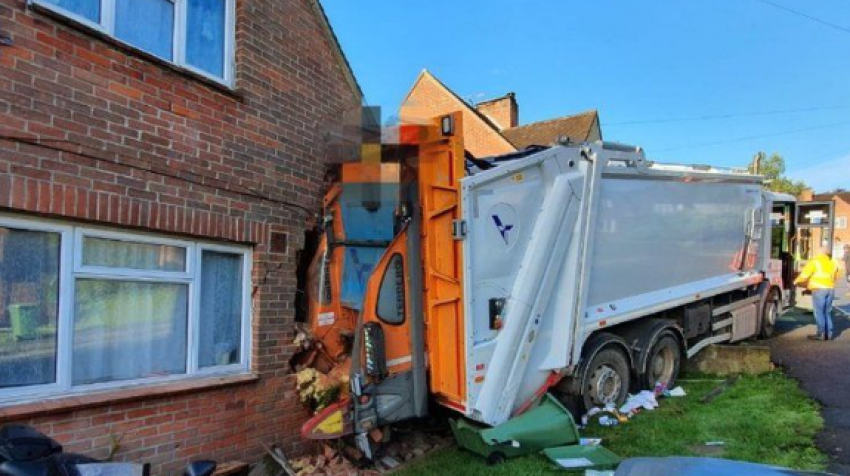
It’s 2025, last November, an unoccupied scaffolding lorry rolled downhill through a residential street in Warmley, near Bristol, took out a row of parked cars and ended up embedded in the front of a house. Two pensioners were in the flat upstairs. The whole thing was caught on camera. One neighbour told ITV it “sounded like a bomb going off.”
Nobody was in the cab. Nobody was hurt — which given it was just after ten on a Friday morning, kids about, people coming and going — was miraculous. The cause? The park brake hadn’t been applied. Driver got out, vehicle rolled, gravity did the rest.
Two drivers dead. Same issue, same cause!
David Lyth, 45, was coupling up at a depot in Widnes. Routine job — backed under the trailer, climbed up on the catwalk, connected his airlines. However, he hadn’t put the handbrake on. Air built up in the trailer, spring brakes came off, the whole lot started rolling. He got caught between his unit and the trailer next to it… and sadly died of asphyxia.
Martin Greenwood, killed at a yard in Tilbury, Essex. Same thing — coupling up, no handbrake, vehicle rolled forward. Crushed between his lorry and a parked trailer. The HSE found neither the cab handbrake nor trailer parking brakes had been applied. Worse, several other drivers at the same company admitted they didn’t always bother. It was just how things were done. The company was prosecuted… the fine will be considerable.
These same types of incidents were identified back in 2015…Ten years on and nothing’s changed
The HSE studied this in 2015. Between 2001 and 2014: 72 RIDDOR-reported rollaway incidents, eight fatalities, 30 major injuries. Number one cause every time — forgetting to put the handbrake on. Distraction, complacency, bad habits picked up over years of getting away with it.
That was a decade ago. The industry was told to sort it out. Here we are in 2026 still writing about drivers dying the same way. The real numbers are far worse — everyone knows most near misses never get reported.
And when it does turn fatal, there’s a grim pattern. The driver sees the vehicle moving, runs for the cab, and gets caught between 30-odd tonnes of truck and whatever’s next to it. That’s what killed Lyth. That’s what killed Greenwood.
OEM warnings aren’t cutting it
Every major manufacturer fits an audible park brake warning. So why are drivers still dying? Because an alarm only works if the driver hears it and acts on it. Stand in any distribution centre at six in the morning — engines ticking over, reversing alarms, shunters moving trailers, bay manager shouting — and tell me a dashboard beep is going to cut through that every time.
The HSE’s own guidance says ‘alarm systems aren’t enough on their own’. That’s the regulator talking. What’s needed is something that acts whether the driver remembers or not.
Park Brake Autobrake — how it works
Doctor Air Brake’s Park Brake Autobrake does what the name says. Cab door opens without the park brake on — the driver gets a loud voice alert (not a beep, a voice) and the system automatically applies the brakes. Vehicle doesn’t move.
It monitors door positions, seat occupancy and air pressure, catching low-air conditions standard sensors miss. Mandatory reset means the driver has to physically apply the park brake before the system clears — no dismissing it and carrying on. Works with the ignition off. Day to day, drivers won’t know it’s there. It only kicks in when there’s a problem — at which point it’s already done the job.
That’s the difference between a warning and an intervention. A warning relies on a human doing the right thing. This takes human error out of the equation.
What it means for operators
The Tilbury prosecution proved that if the HSE finds you didn’t have a safe system of work in place after a fatal rollaway, you’re likely to be prosecuted under the Health and Safety at Work Act. Company, directors, transport managers — personally. Corporate manslaughter isn’t off the table. Six-figure fines before the civil claims even land.
Then there’s your O-Licence. A traffic commissioner seeing a rollaway fatality on your record will want answers at a public inquiry. If they’re not good enough, outcomes go from undertakings to revocation. Lose the licence, lose the business.
Insurers are asking sharper questions about active safety kit too. Showing you’ve fitted a system that physically prevents rollaways is a different conversation to just running the standard OEM buzzer. And the property damage speaks for itself — Warmley was one lorry, one handbrake, one street. The cost of fitting Park Brake Autobrake to your entire fleet wouldn’t come close to the bill from a single incident like that.
The bottom line
Every incident in this piece was avoidable. The technology exists, it’s proven, and it works. The question is simple: are you relying on your drivers remembering every time — or fitting a system that makes the whole problem go away?
Doctor Air Brake — 01785 714447 | sales@air-brake.com | www.air-brake.com/safety-system/parkbrake-warning