Reversing incidents remain one of the most persistent causes of serious injury and death in the waste and recycling sector. Refuse collection vehicles, road sweepers, skip wagons and tippers operate on confined kerbside rounds, in busy depots and at transfer stations — often within metres of pedestrians, cyclists and colleagues on foot — where traditional controls such as alarms, mirrors and cameras rely heavily on driver reaction time and situational awareness.
The numbers make the case. Waste and recycling remains one of Britain’s most dangerous sectors to work in: HSE figures show six workers died in 2025/26, a fatal injury rate of 5.47 per 100,000 — around ten times the all-industry average and second only to agriculture, forestry and fishing. Being struck by a moving vehicle accounts for roughly 17% of workplace deaths across all industries, but that figure rises sharply to 48% in waste and recycling. Workplace transport makes up around 30% of the sector’s fatalities, and nearly a quarter of all workplace-transport deaths happen while a vehicle is reversing.
ReverseSmart is engineered to remove that dependency.
At the core of the system is a 77GHz radar platform, continuously scanning a programmable detection field behind the vehicle. Unlike optical systems, radar performance is not degraded by dust, rain, spray or darkness, a critical factor on early-morning rounds and dusty transfer sites. The sensor tracks both distance and closing speed, building a real-time model of objects within the vehicle’s path.
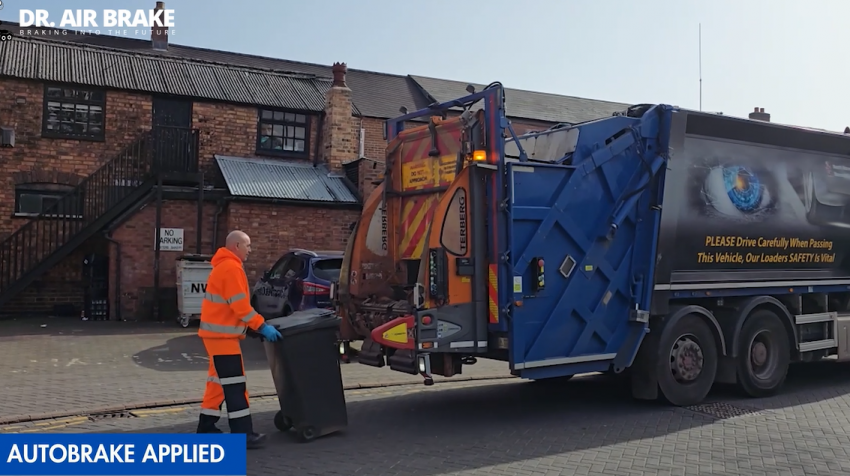
When an object or person enters the defined danger zone, the system escalates through a staged response. Initial detection triggers audible and visual alerts in the cab, giving the operator time to react. If no corrective action is taken and the risk increases, ReverseSmart transitions from warning to intervention, autonomously applying the service brake, but not the park brake, using a controlled pulsing action. By modulating braking force rather than locking the drivetrain, it delivers a controlled stop without introducing mechanical stress or instability.
The braking logic is fully configurable. Detection zones, beam width, trigger thresholds and braking response can all be tailored to the vehicle type and duty cycle. ReverseSmart communicates directly with the vehicle via CAN bus, enabling seamless interaction with existing braking and control systems while maintaining OEM integrity. It can also be linked to onboard camera and MDVR platforms, automatically recording every autobrake event with time-stamped footage for post-incident analysis — moving safety management from assumption to evidence.
Operators are already seeing the difference in the field. Dawsongroup EMC has fitted ReverseSmart across its road sweeper fleet.
“The safety enhancement has been immediate and noticeable. In the past, there was always the concern that a driver might not be aware of a person in the blind spot directly behind the vehicle, especially in busy yards and work environments. The system automatically detects any person in the vehicle’s path and provides both audible and visual warnings as the vehicle gets closer. If the driver is unable to react in time, it goes a step further, automatically applying the brakes to prevent a potential accident. We’ve already seen how effective it can be in real-world situations. It’s not just a system; it’s a vital safety feature that sets us apart in a competitive market, and we’re confident it’s making our customers’ worksites safer and more efficient every day.”
Mike Firth, Dawsongroup EMC
Jeff Lowe, Managing Director of Doctor Air Brake, said the technology addresses a long-standing gap in fleet safety.
“Operators have had warnings for years, but warnings don’t stop vehicles. This system physically intervenes — and just as importantly, it records exactly what happened. That combination of control and evidence is what the industry has been missing.”
Jeff Lowe, Managing Director, Doctor Air Brake
The compliance case is hardening too. Regulators increasingly treat reversing fatalities as systemic failures rather than isolated driver error, with recent enforcement in the sector reaching fines of up to £2.5 million, including cases involving a reversing skip wagon and a reversing road sweeper. With the HSE valuing the human cost of a single workplace fatality at around £1.6 million, and the Health and Safety at Work etc. Act 1974 requiring operators to demonstrate that risks are not only identified but actively controlled, systems that both intervene and provide verifiable data are moving from optional extra to expectation.
Designed for integration across the full range of HGVs — rigid refuse vehicles, road sweepers, tippers and skip loaders — regardless of powertrain, ReverseSmart brings a single principle to the toughest waste environments: the vehicle stops. No matter what.
REQUEST A DEMONSTRATION See how ReverseSmart can transform your fleet safety. Contact the team on 01785 714447 or john.grindey@air-brake.com.