Walk into almost any workshop on a Monday morning and you'll see the same scene play out: a tractor unit idling in a bay when it ought to be on the road, two technicians circling a trailer like they're performing the usual maintenance ritual, and someone shouting "BRAKE!" across the floor like it's a military drill. It's familiar, it's comfortable, and it's a colossal, unnecessary drain on time, labour and money.
For years, nobody questioned it. It was simply "This is how trailer checks were done." But the industry has changed. Labour is thin on the ground. Tractor units are too valuable to waste on MOT preps. And operators are under pressure to squeeze more out of every hour and every technician. Which is why what's happening now matters: a complete rethink of how one technician can do what used to need three people, a driver, and half a morning vehicle shuffling.
The VTC Moment - “The old rules die”
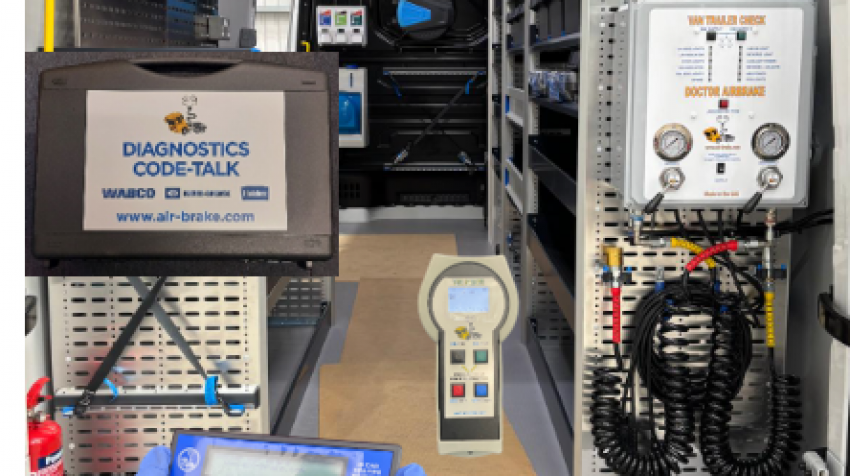
The moment you plug in a VTC, the old rules die. This isn't some conceptual tool that looks good in a brochure but disappoints in the bay. It's a portable tractor unit simulator that creates a fully electrical and pneumatic environment, and suddenly a single technician becomes completely autonomous. No tractor unit. No driver. No shunter. No waiting. The trailer thinks it's talking to a live unit, and the technician is free to run lights, brakes, ABS and CAN diagnostics at full tilt without anyone else involved.
That's when you realise something uncomfortable: half the obstacles in trailer servicing were self-inflicted. “Service engineers were effectively tying up expensive units in bays for no reason” states Jeff Lowe MD of Dr Air Brake. Fleet managers were expected to move trailers around like chess pieces because "that's just how you do it." And effectively throwing bodies at processes that is effectively is now a one-man job. The VTC doesn't ask for fuel, it doesn't need a coffee break, and it doesn't cause a traffic jam in the yard. It just gets on with the job while your actual tractor unit stays on the road earning money.
Wireless Control Changes Everything – ‘exposes how primitive the old method was’
The Wireless Remote doesn't just streamline work, it exposes how primitive the old method was. The moment a technician controls every lighting function and every brake command from wherever they're standing, the absurdity of the traditional becomes impossible to ignore. No more running back and forth between the control unit and the rear of the trailer. No more miscommunication. No more squeezing under a trailer only to realise no one pressed the brake.
The job becomes cleaner, quieter, faster and safer because the technician stays at the point of work with total control in their hand. Checking for binding brakes? Activate them while you're watching the wheels. Recording air pressures? Do it without walking anywhere. Inspecting hub assemblies? Keep the remote in your pocket and work uninterrupted. One technician does all of it without choreography, without help, without wasted steps. Cut half an hour of labour from every trailer check and multiply that across twenty units a week. The numbers add up fast.
Diagnostics Without the Drama ‘The final piece in the puzzle’
Then there is Code Talk II which has been dubbed as the technician's secret weapon. Forget the laptop drama, forget software updates, forget waiting 48 hours for someone with the right system to show up. The tech plugs in Code Talk II and gets dealer-grade diagnostics instantly: wheel speeds, voltages, pressures, fault codes, live data. If a fault needs clearing, it's cleared right there on the spot.
This is where the cost savings get brutal. A main dealer call-out for EBS diagnostics can easily hit £200-300, more if it's out of hours. A multi-brand laptop diagnostic system? Several thousand pounds plus annual software subscriptions that make your accountant wince. Code Talk II delivers the same intelligence for a fraction of the cost, and it doubles as an advanced controller for the VTC. Suddenly mobile techs aren't limited, workshops aren't held hostage by laptops, and trailers don't sit around waiting for crucial diagnostics. The one-man system rolls on without interruption.
Safety That Actually Works
And while all that is happening, ISO Check sits quietly ensuring everything is safe enough to move. A simple green light confirms the trailer's ISO 7638 connection is healthy. A red light tells the technician something's wrong before a driver pulls out, before an EBS system throws a tantrum, before DVSA gets involved. The premium version even identifies which specific pin has failed, slashing diagnostic time and preventing the kind of roadside prohibitions that cost operators a fortune in downtime and reputation damage.
It's brutally simple, and the best safety systems always are. This isn't fancy kit trying to impress anyone. It's unglamorous insurance against the kind of failures that turn routine deliveries into expensive disasters. Compared to a trailer arriving at a customer site with dead EBS or a prohibition notice, ISO Check is cheap and offers peace of mind.
The Real Revolution
Put it all together and you realise something huge: this isn't four tools, it's a complete teardown of the old workshop model. One technician now does what used to require a driver, a second tech, and a tractor unit. The shouting stops. The waiting stops. The wasted labour stops. The excuses stop. In their place: speed, precision, autonomy, safety and control.
Run the numbers on a medium-sized operation doing thirty trailer services a week. Strip out the second technician, the shunter time, and the tractor unit availability issues, and you're looking at 15-20 hours of recovered labour weekly. That's essentially a full person's worth of productivity handed back. For mobile technicians the calculation is even simpler: either you can test trailers on-site or you can't. If you can't, they're getting towed to a workshop at £150-200 a vehicle. The kit pays for itself in a month.
This isn't a revolution built on gimmicks. It's a revolution built on common sense that the industry somehow missed. The era of the one-man trailer service has arrived, not quieter or softer, just smarter. One man, four tools, zero compromise, and no more standing around shouting about brake lights.
Ends
John Grindey
john.grindey@air-brake.com