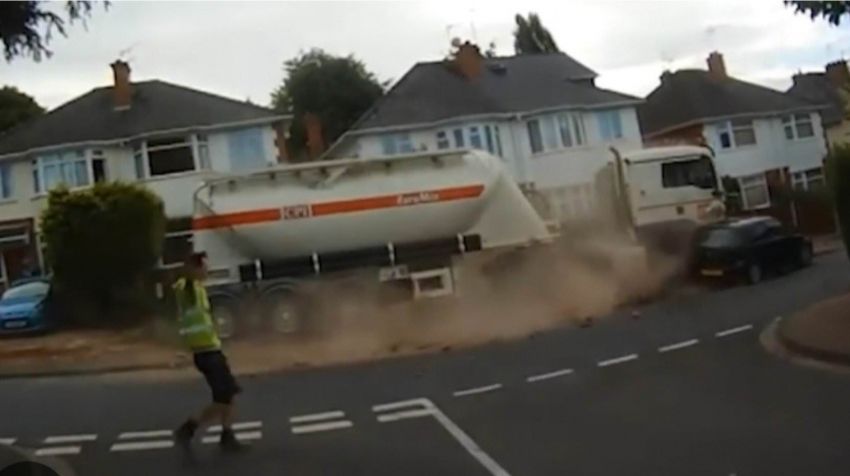
Recent video footage released by the Daily Record in Edinburgh captured a moment that has become increasingly familiar to fleet safety professionals: a heavy goods vehicle, parked and unattended in New Town on Hanover Street, suddenly begins to roll away. The several-tonne HGV gathers speed down a small incline, passing within feet of two pedestrians who remain entirely unaware of the danger. The lorry continues its silent descent, mounting the curb and rolling directly across a pedestrian path before finally crashing into a domestic wall. The pedestrians walk on, oblivious to what one witness later described as their "miracle escape."
The footage is chilling not because of what happened, but because of what almost happened. The vehicle crossed the exact space where pedestrians walk, where parents push prams, where anyone could have been standing at that precise moment.
When Luck Runs Out
Weeks later, 89-year-old Daphne Stallard was killed on a narrow residential street in Llandudno when she was struck by a reversing Conwy Council recycling lorry. Emergency services, including an air ambulance, attended the scene. She was pronounced dead shortly after. The driver was arrested on suspicion of causing death by dangerous driving and later released under investigation.
Two incidents within several weeks of each other. One a near-miss that saw a runaway lorry mount a curb and cross a pedestrian path before slamming into a wall, the other a fatality that left a family grieving and a driver facing potential criminal charges. Both involved routine fleet operations in urban environments. Neither involved recklessness or deliberate negligence. And as Jeff Lowe, the MD of Dr Air Brake points out, "Both were entirely preventable with technology that already exists and is in use across the UK."
The incidents have reignited a question that fleet managers and local authorities can no longer avoid: at what point does failing to adopt available safety technology move from unfortunate oversight to corporate negligence?
The Legal Landscape Has Changed… “With a price tag of up to 25 years in prison and an unlimited HSE fine”
The answer, according to health and safety law, is clearer than many fleet operators might realise. Under the Health and Safety at Work Act 1974, employers must do everything "reasonable and practical" to eliminate or control risks to workers and the public. When proven technology exists that can prevent a foreseeable incident, choosing not to implement it becomes increasingly difficult to defend.
The Corporate Manslaughter and Corporate Homicide Act 2007 established that organisations can be prosecuted when failures in management systems lead to death. Investigators examine whether all reasonable steps were taken to prevent the incident. The existence of affordable, proven safety systems that were not implemented becomes a critical factor in establishing liability.
After the Llandudno incident, these questions become inevitable: Was the risk of reversing collisions foreseeable in narrow residential streets? Yes. Could technology have prevented it? Yes. Was the technology in place? Undoubtedly no.
The shift from driver culpability to corporate responsibility reflects a fundamental change in how workplace safety is understood. Individual human error will always occur. The question is whether management systems are designed to prevent those errors from becoming fatal.
Technology That Fills the Gap
“It’s not the driver’s fault that the lifesaving equipment wasn’t fitted it’s the executives… It’s their responsible for this level of safety”
Developments in intelligent vehicle safety systems have fundamentally changed what constitutes "reasonable and practical" protection.
Reverse Smart™, developed by Dr Air Brake, uses an integrated radar sensor system to detect pedestrians or obstacles in a vehicle's reversing path. Unlike simple parking sensors that only alert the driver, Reverse Smart™ automatically cuts power and applies the brakes when an obstruction enters the danger zone. The intervention is immediate and requires no driver input. In confined spaces like Llandudno's residential streets, where visibility is inherently compromised and a driver's attention is divided between multiple hazards, such a system provides a final safety barrier that doesn't depend on human reaction time.
Similarly, the Auto Park Brake addresses the other critical vulnerability: unattended vehicle movement. The system automatically applies the parking brake whenever the driver opens the either cab door and monitors other variables such as low air and speed. Even on an incline, the vehicle is mechanically secured with no risk of moving. Had this been fitted to the Edinburgh HGV, the rollaway that mounted the curb and crossed the pedestrian path could not have occurred. The vehicle would have stopped itself the moment the driver opened the door.
What makes these systems significant from a legal and operational perspective is that they don't require perfect driver compliance or situational awareness. They function as engineered safeguards that operate independently of human factors—fatigue, distraction, time pressure, or simple momentary inattention.
The Evidence Base
The effectiveness of such systems is no longer speculative. Data from UK fleets shows measurable safety improvements. Local authority waste and recycling fleets—the very sector involved in the Llandudno incident—have reported zero reversing collisions following installation of detection and auto-braking systems. Construction fleets using automatic parking brake technology have eliminated rollaway incidents entirely. National logistics operators have documented reductions in accident-related vehicle downtime and insurance claims exceeding forty percent.
These results establish that the technology is not experimental or unproven. It is operational, reliable, and delivering documented safety improvements in real-world conditions across multiple sectors.
A Preventable Pattern
What connects these incidents is not bad driving or inadequate training. It's the gap between human capability and mechanical consequence. A momentary lapse—failing to fully engage a handbrake, misjudging a reversing angle in a confined space—creates forces that no amount of subsequent human reaction can counteract. Several tonnes of vehicle moving under momentum cannot be stopped by awareness or intention alone.
Before the Next Incident
“If its left to human error…There will be another rollaway... There will be another reversing collision…The only variables are when, where…”
For fleet managers reviewing their safety protocols in light of Edinburgh and Llandudno, the path forward is increasingly clear. Fitting intelligent braking and reversing protection is no longer about being at the cutting edge of safety technology. It's about meeting the basic standard of care that current technology and legal expectations now define.
You can repair a vehicle. You can manage insurance claims. You can revise training protocols. But you cannot bring someone back from the dead. And you cannot credibly claim that their death was unforeseeable when the means to prevent it were readily available and you chose not to use them.
There's no coming back from killing someone. But there is still time to prevent it.
Dr Air Brake
Reverse Smart™ and Auto Park Brake – Designed to Save Lives. Built to Protect Yours.